Keep your ads seasonal: how to time creative refresh cycles

min read
How to time creative refresh cycles in mobile game user acquisition (UA). When to refresh, how to spot creative fatigue, and how to plan a seasonal ad calendar.
The best mobile UA campaigns don't run the same creative forever. They rotate. They refresh. They lean into moments when the audience is paying attention and back off when it isn't. And the studios that treat creative refresh as a discipline, rather than a reaction, tend to compound performance over months instead of burning through budget every quarter.
This guide covers how to think about creative refresh cycles for mobile games. When to refresh, why timing matters more than most teams realize, how to spot creative fatigue before it eats your ROAS, and how to use competitive signals to time your own creative planning.
Why timing matters more than most teams realize
Two things have changed in mobile UA over the past few years that make creative timing much more important than it was in 2020 or 2022.
Creative fatigue is faster. With more games in market, more ads competing for the same audience, and shorter attention windows, creatives fade faster. A creative that performed for six months in 2020 might now start losing efficiency after six weeks.
Networks have become more creative-hungry. Every major ad network's algorithm rewards fresh creative supply. Feeding the algorithm new variants continuously improves ranking, targeting, and reach. Studios that ship creative rarely see their campaigns cool off between refreshes.
Combined, these two shifts mean that the studios that ship fresh creative frequently and time refreshes to real moments in the calendar tend to outperform the ones running the same three creatives for a year.
What creative fatigue actually is
Creative fatigue is the decay in ad performance that happens when the same creative runs to the same audience for too long. Impressions keep costing the same. Conversions drop. ROAS falls. If left unchecked, the campaign quietly loses profitability while the dashboards still look busy.
The mechanics are simple. When an audience sees an ad they've seen before, they scroll past it. When they see a familiar ad three times, they scroll faster. When they see it ten times, they've stopped noticing. Meanwhile, the ad network is still spending your budget to reach them.
Fatigue kicks in at different speeds depending on the game, the audience, the format, and the network. As a rough working baseline in 2026:
- Hyper-casual creatives: 2 to 6 weeks
- Hybrid-casual creatives: 4 to 10 weeks
- Midcore and casual titles: 6 to 12 weeks
- Playable ads: often longer than video, because higher production cost and stronger differentiation
These are averages. Some creatives run productively for six months. Some burn out in two weeks. The point isn't the exact number. The point is that treating creative as a set-and-forget asset misses the natural rhythm of how ads perform.
The seasonal calendar for mobile games
Seasonality in mobile UA works on two overlapping calendars: the shared global one (holidays, seasons, real-world events) and the game-specific one (in-game events, updates, monetization pushes).
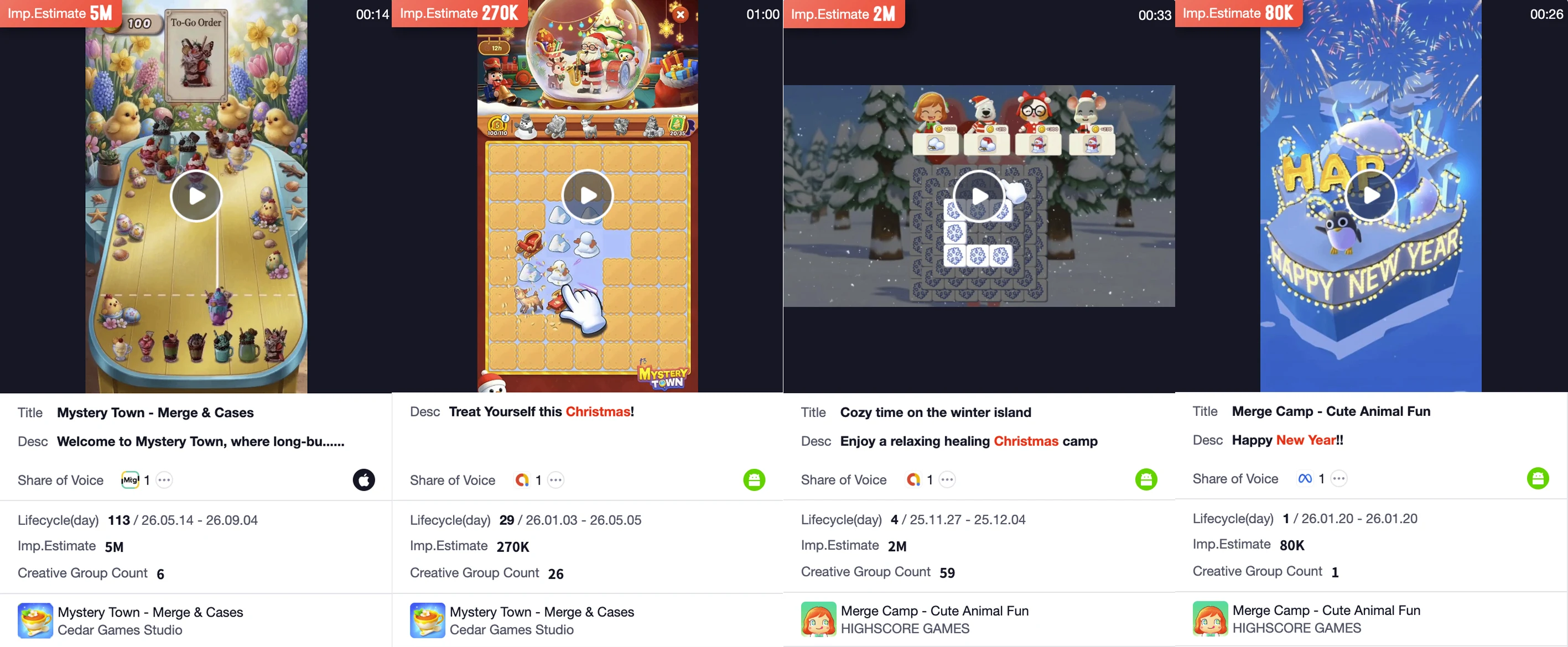
The shared calendar is worth planning around because attention shifts predictably. When players are thinking about pumpkins in October, ads that lean into pumpkins land better. When it's Chinese New Year in APAC, red-and-gold creatives cut through the feed. When schools are on summer break, kids and parents have more screen time. These aren't small effects. They're often the difference between a campaign that fills the funnel and one that doesn't.
Key windows in the 2026 mobile UA calendar most studios plan around:
- January to February: New year resolutions, Chinese New Year (varies), Valentine's Day. High spend in fitness, dating, casual games.
- March to April: Ramadan and Eid (varies), Easter, spring break. Strong in-app activity across most Western markets and MENA.
- May to June: Mother's Day, Father's Day, Pride Month, end of school year. Family-oriented and casual games see engagement lift.
- July to August: Summer break, Prime Day. Highest install volumes in many Western markets. Also lowest CPMs for some networks.
- September to October: Back to school, Halloween. Kids' games benefit, but so do horror, RPG, and adventure themes.
- November to December: Black Friday, Cyber Week, Diwali, Christmas, holiday break. The single biggest UA and IAP window of the year for most mobile games.
None of these are surprising. What's surprising is how often UA teams don't plan creative refreshes around them, or plan them but ship the new creatives two weeks after the moment has passed.
The rule of thumb: for any seasonal window worth planning around, your refreshed creative should be live in market at least two weeks before the moment, not after it.
Signals your creatives need a refresh
Even outside seasonal moments, creatives should get replaced when performance signals decay. The best UA teams treat these signals as tripwires, not surprises.
Impressions are steady, but installs are falling. Classic creative fatigue. The ad is still being shown. The audience just isn't responding anymore.
CPI is climbing without a targeting change. If nothing else changed in the campaign structure and CPI is trending up, creative fatigue is often the reason. The algorithm is having to push the ad harder to find someone who'll convert.
Frequency is rising for a stable audience. If the same users are seeing your ad more times per week than before, and audience size hasn't grown, the algorithm has run out of new people to reach and is re-serving the same ones.
Engagement metrics are dropping. If comments, saves, and click-through are declining while impression volume is stable, the creative has stopped standing out in the feed.
A specific network's performance is diverging. If your creative was performing similarly across networks and one network's ROAS is suddenly falling behind, the audience on that network has fatigued faster (often the case for networks with smaller unique audiences).
Post-install behavior is drifting. If new users from a specific creative are churning faster or spending less than users from a month ago, the creative may have started attracting a lower-quality audience segment.
Any one of these signals on its own can be noise. Two or more happening at once usually mean it's time to refresh.
Building a refresh cadence
Creative refresh works best as a rhythm, not a fire drill. A cadence that most mobile UA teams find sustainable:
- Weekly: One or two new creative variants shipped to your top campaigns. Small iterations of proven winners (new hooks, alternate CTAs, seasonal color changes) count as variants and feed the algorithm.
- Monthly: A larger creative push tied to the coming month's seasonal opportunities. New concepts, new formats, new angles. Ideally briefed off the results of the previous month's testing.
- Quarterly: A deeper review. Which creative concepts have compounded? Which have plateaued? Which new formats or hooks have emerged in the market that we haven't tested? What's the seasonal calendar for the next quarter?
- Annually: A full creative strategy reset. Are we still going after the right audience? Are our winning concepts still winning, or are they aging out? What has the market shifted toward that we haven't adapted to?
For smaller teams, or indie studios without the production capacity for a weekly cadence, the monthly and quarterly rhythms still work if the weekly one is out of reach. The important thing is that refresh is scheduled, not accidental.
Using competitive signals to time your refreshes
Competitive signals are one of the strongest inputs to creative refresh timing. If a competitor with a similar game is testing a new hook, format, or theme, you'll want to know before your own next refresh cycle, not two months after it.
Ad intelligence tools like Ad Insights surface this signal in a few useful ways. See the Ad Insights features documentation for how each of these maps to a live tool.

New creative from tracked competitors is often the first signal to watch. Studying what your closest competitors launch, especially in the weeks before a seasonal moment, tells you where the category is heading. If three competitors all pivot to Halloween-themed creatives in early October, that's a signal about the audience state, not a coincidence.
Ad lifecycle patterns are the next layer. Studying how long competitors run creatives before retiring them gives you a working sense of how long your own creatives should be expected to last, and category norms are useful sanity checks when your instinct wants to refresh too soon or too late.
Beyond individual creatives, watch for creative format shifts across your genre. If competitors are moving from video-first to playable-first, or from single-hook to multi-hook video, that's a signal worth acting on before the market catches up.
Regional patterns matter too, since some seasonal moments are region-specific. Ad Insights' regional filters let you see what creatives are running specifically in the markets you care about, which is more useful for regional planning than global averages.
Finally, watch for store listing changes. Competitors often update their store listings alongside seasonal creative refreshes, so tracking these signals through Ad Insights' store listing change tracker gives you extra lead time on when a competitor is preparing for a big moment.
Studying the market shouldn't drive every creative decision. But timing your refresh cycles against real competitor and category movement, rather than against gut feel, is one of the most consistent ways to sharpen ROAS across a full year.
Building a refresh workflow that compounds
A creative refresh cycle that works over a full year usually has three moving parts.
- A calendar you plan against. The rolling seasonal moments for the coming quarter, mapped to your key markets, with intended refresh dates set two to three weeks before each moment.
- A signal set you monitor continuously. The tripwire metrics (CPI trend, frequency, engagement decay, cross-network divergence) that tell you when a creative is fatiguing outside your planned refresh windows.
- A competitive research routine. A regular check on what's launching in the market, so your creative planning is informed by category signal rather than just internal brainstorming.
Studios that build these three habits into their UA operation, rather than treating refresh as a reactive task, tend to compound creative performance year over year. Studios that treat refresh as something they'll do "when we get a chance" tend to spend the same amount and get less back for it.
The bottom line
Creative refresh isn't a one-time project. It's the rhythm that separates UA operations that compound from ones that plateau. In a market where creative is the dominant lever and networks reward fresh supply, the studios that plan their refresh cadence, watch for fatigue signals, and time their creative pushes to real moments will consistently outperform the ones that don't.
The seasonal calendar gives you the beats. Fatigue signals tell you when to move outside them. Competitive intelligence tells you what patterns to pay attention to. Together, they're the three inputs into a creative operation that keeps improving instead of slowly running out of steam.