Why holiday seasons don’t drive mobile game spending the way you’d expect

min read
Black Friday and the broader holiday season reshape retail revenue every year. In mobile games, the impact is far smaller than most studios assume. Here’s what the data shows across Black Friday, Cyber Monday, Christmas, and the stretch of holidays that follow, and why mobile game monetization follows a different calendar than retail.
Black Friday 2025 pulled in $11.8 billion in US online sales. Cyber Monday added $14.25 billion. Mobile commerce accounted for more than 57% of Cyber Monday purchases. If you worked in mobile gaming that November, you probably felt the pressure to ship a holiday offer, a seasonal reskin, or a limited-time bundle. And then you probably watched the numbers come in flat.

The gap between what retail does during the holidays and what mobile gaming does is, however, quite big. And the same pattern holds across Christmas, New Year, and the string of seasonal moments that follow. This piece looks at what the data shows across the broader holiday season, drawing on reports from Adobe, AppsFlyer, Adjust, Sensor Tower, Moloco, AppMagic, and our own benchmark data across roughly 1,800 paying mobile games.
The retail backdrop
For context on the expectation most studios are working against: Adobe reported total US online spending of $257.8 billion between November 1 and December 31, 2025, with mobile commerce accounting for more than half of all online spending. As Vivek Pandya, Lead Analyst at Adobe Digital Insights, put it:
Competitive and persistent deals throughout Cyber Week pushed consumers to shop earlier, creating an environment where Black Friday now challenges the dominance of Cyber Monday.
In broad e-commerce terms, the holiday season is a genuine revenue event. It’s the context mobile game teams are working inside when they plan Q4 and where the expectation gap starts.
What mobile games actually see across the holidays
The industry-wide picture is more muted than the retail one. Sensor Tower’s State of Mobile 2026 report put global mobile game spending at $81.8 billion in 2025. For context, non-game app spending grew 21% year over year while games grew more slowly, and no new mobile game crossed the $1 billion revenue mark in 2025. The Sensor Tower report described 2025 as a “year of divergence for mobile gaming.” Mobile gaming is growing, but not through holiday bursts.
AppsFlyer’s State of Gaming for Marketers 2026 reinforces the same pattern from the UA side. Based on anonymized data from 9,600 gaming apps, AppsFlyer found that mobile games spent $25 billion on user acquisition in 2025, up only 3.8% compared to 2024, with iOS rising 6% and Android 2%. For comparison, non-gaming app marketing spend grew 18% to $53 billion in the same period. Shopping category investment alone increased 70% overall and 123% on iOS. The money is flowing into apps that make money from holiday shopping. Mobile games aren’t one of those categories.
PocketGamer.biz reported that US Black Friday mobile game spending reached roughly $70 million in a recent benchmark, up 25% year over year. That’s a real signal, but $70 million against an $81.8 billion annual market works out to less than 0.1% of the year in a single day. The holiday matters in a specific regional and platform slice and doesn’t move the global picture.
Tebex, which processes payments for PC and mobile games, saw 58.9% year-over-year growth on Cyber Monday 2025 and 33.6% on Black Friday. But Tebex is heavily weighted toward PC, where buying patterns are closer to retail than they are to mobile free-to-play.
Moloco’s seasonality analysis of the 2025 holiday period describes the pattern clearly:
Downloads surge in late November around Thanksgiving and Black Friday, then peak over Christmas and New Year at more than 40% above the start of Q4.
Downloads rise clearly. Spending, less so.
Adjust’s analysis of its own 2025 holiday data noted the same tension:
The holiday season offers more than short-term spikes. The opportunity now is to operationalize what the data shows.
In other words, the real value sits in understanding the sustained pattern, not in optimizing for a single day.
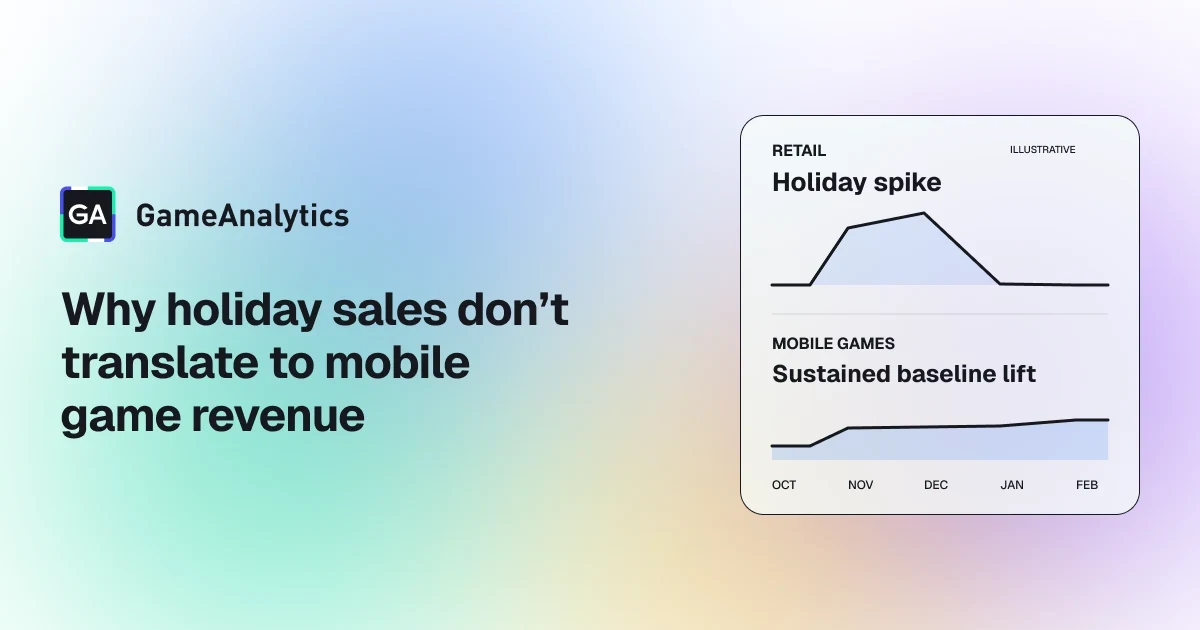
Our Benchmarks Hub backs this up. Across roughly 1,800 paying mobile games with monthly active users above 10,000, median ARPDAU in November 2025 rose 16% over October, from $0.0091 to $0.0105. That lift held through December, January, and February, which actually posted a higher median ARPDAU at $0.0112. Rather than a Black Friday spike that reversed, the data shows a step change in the baseline that persisted.
Two metrics that should move most if players were buying more during a holiday sale went the wrong direction. ARPPU fell in November to its lowest point in the eight-month window at $9.99. Transactions per payer dipped slightly to 1.97. If Black Friday were pulling extra purchases through, you would expect payers buying more often or spending more each time. The data shows neither.
The holiday signal is advertising
Among all the metrics in our benchmark data, only one moved cleanly with the holiday season. Ad ARPDAU rose to $0.0293 in November 2025, the highest reading in the eight-month window, before falling back in December and January.
This is advertiser behavior, not player behavior. Commerce advertisers compete with game advertisers for the same mobile ad inventory in the same auctions, and their holiday spending pushes impression prices up. The Playio analysis of Q4 advertising frames the dynamic plainly:
For mobile game UA teams, Q4 contains both the most expensive and the cheapest stretches of the year. In November, ahead of Black Friday, commerce advertisers compete for the same mobile placements and push impression prices up.
Singular’s Q4 2024 Quarterly Trends Report found similar seasonality on the UA side, reporting “global ad spend jumped +24% on both iOS and Android as marketers ramped up for holiday seasonality,” with iOS CPIs spiking +44%, the biggest increase in over a year.
For most mobile game studios, the holiday window isn’t a monetization opportunity. It’s a user acquisition cost pressure that compresses creative windows and forces teams to think about creative rotation differently in Q4. Teams that extend proven creative into the holiday window with light seasonal copy swaps protect margin when CPMs spike, which is exactly what the top-performing games do. We looked at this pattern in more detail in our analysis of creative refresh cycles in mobile UA.

Why the holiday season doesn’t move mobile game spending
Four structural reasons explain why mobile gaming’s calendar doesn’t match retail’s.
- The perpetual promotional cadence. Mature mobile games already run continuous events year-round. GameRefinery’s analysis of in-game events found that “over 90% of the top-grossing 100 iOS mobile games actively use seasonal events to boost their revenues”. Seasonal events aren’t a Q4 moment anymore. They’re a year-round operating model. The AppMagic LiveOps Report 2025, summarized by Mobidictum, puts it even more directly: “LiveOps in 2025 became one of the primary monetization growth engines in the slowing down mobile games market. Importantly, LiveOps expansion is not directly driven by seasonal spikes.” The report shows a seasonal peak in October at 91 events per game per month in casual games, but the broader picture is one of steady growth throughout the year rather than concentrated holiday pushes. When players can expect a sale almost every week, a Black Friday discount isn’t the differentiator it is in retail.
- The webshop effect. Direct-to-player webshops powered by platforms like Xsolla, Appcharge, and FunPay are increasingly where promotional pushes happen. Xsolla’s own analysis frames holiday events as “a critical component of mobile game monetization strategies,” but the webshop model is optimized for recurring high-margin sales year-round. The more revenue that moves through webshops, the more the seasonal spike flattens, because the promotional opportunity is distributed across the full calendar rather than concentrated in November and December.
- The ad-to-IAP mix is shifting. The rise of rewarded video and hybrid casual monetization has made ad ARPDAU a larger share of total revenue in many games. Ads respond to advertiser demand, which spikes at Black Friday. Player purchase intent in games doesn’t spike the same way. This is exactly what our benchmark data shows: Ad ARPDAU moves with the holiday season, ARPPU doesn’t.
- The calendar extends past December. The ARPDAU lift that starts in November persists through Q1, and February 2026 is higher than November at the median. Deconstructor of Fun’s analysis of Toon Blast and other long-running titles consistently points to the operational discipline of continuous feature iteration rather than seasonal pushes as the real driver of revenue. Chinese New Year prep, Valentine’s Day events, and the start of new annual budgets likely do more for mobile game revenue than Black Friday ever will. Studios building their calendar around the holiday peak are optimizing for the wrong timeframe.
What this means for how you plan around holidays
For most mobile games, dedicating serious creative and team resources to a Black Friday-specific moment is not the return on investment play it looks like. Light seasonal re-skinning of existing offers, extended across multiple holidays, almost always beats a bespoke push. The real Q4 story is advertising cost pressure, which argues for planning creative rotation around the window rather than planning a monetization spike that most games won’t see.
If a game is heavily US-weighted, a Black Friday push can move the needle, but it’s competing against higher user acquisition costs and a saturated promotional feed. Globally weighted games should think about the holiday calendar differently: as a flat baseline lift that persists into Q1, not a peak to optimize around. And if a team only has resources for one deep seasonal moment, December content plus Chinese New Year prep will outperform Black Friday for most global mobile games.
The broader lesson is about where the real monetization leverage sits in modern mobile gaming. LiveOps cadence, webshop optimization, and genre-appropriate event design do more over the course of a year than any single holiday push. As the AppMagic report concluded, LiveOps growth “is not directly driven by seasonal spikes.” The holidays are visible. They are not where the revenue actually lives.