The complete glossary of ad and creative intelligence terminology

min read
A complete glossary of ad and creative intelligence terminology for mobile games. Definitions of every term UA and creative teams need to know in 2026.
Ad intelligence, creative intelligence, and mobile user acquisition have their own vocabulary. Some of the terms are used loosely across the industry, some mean different things in different platforms, and some are new enough that even experienced UA managers hedge their definitions. This glossary is a working reference for the terms that show up most often in mobile UA, creative research, and competitive analysis conversations in 2026.
Terms are grouped by category. Where a term has a direct product feature or documentation counterpart, we've linked out.
Ad and creative intelligence foundations
- Ad intelligence: The practice of collecting, analyzing, and acting on data about advertising activity across the market. For mobile games, that means understanding which studios are advertising, where they're advertising, how much they're spending, what creatives they're running, and who they're targeting. See our complete guide to ad intelligence.
- Creative intelligence: The subset of ad intelligence focused specifically on the advertising creatives themselves. What the ads look like, what patterns connect the winners, how they evolve over time, and how top studios structure their creative production. See our complete guide to creative intelligence.
- Market intelligence: The broader category covering everything about a market beyond ads. Downloads, revenue, DAU, retention, category share, top charts, and market movement. Often used interchangeably with market research.
- Competitive intelligence: A general term for research into competitor activity across every dimension of their business, including advertising, monetization, product, and organization.
- Ad tracking: The continuous monitoring of ad creatives, ad networks, and campaign activity. In the context of ad intelligence tools, this usually means tracking what competitors are running, not tracking your own campaigns.
- Creative research: The disciplined practice of studying ads in market to inform your own creative decisions. Overlaps heavily with creative intelligence, but often refers to the human workflow rather than the tool that supports it.
- Ad Insights: GameAnalytics' ad and creative intelligence platform. Combines ad intelligence, creative intelligence, and market signals in a single workflow. See the Ad Insights overview.
Ad creative types and formats
- Video ad: An ad that plays a video clip. The dominant format across mobile game UA in 2026, typically ranging from 6 seconds to 60 seconds.
- Playable ad: An interactive ad that lets the user play a short version of the game inside the ad unit. Higher production cost, but consistently strong performance for aligning UA with actual gameplay.
- Image ad: A static banner, tile, or full-screen image ad. Less common in mobile game UA than video, but still used across banner placements and store spots.
- Interstitial ad: A full-screen ad that appears between content transitions, typically in mobile games. Can be video, image, or playable.
- Banner ad: A small ad placement, typically at the top or bottom of the screen. Lower CPM than interstitials or rewarded, still used for continuous impression volume.
- Rewarded video: A video ad that gives the player an in-game reward in exchange for watching. Some of the highest engagement rates in mobile advertising because the player opts in.
- End card: The static or interactive screen that appears at the end of a video ad, usually containing the install CTA. Often the most-optimized element of a video ad.
- Web-to-app (W2A): A campaign type that drives users to a web landing page first, then to the app store. Common in creative-heavy strategies where the landing page enables extra targeting, testing, or storytelling.
- App Store Redirect: A campaign type that drives users directly to the app store listing from an ad.
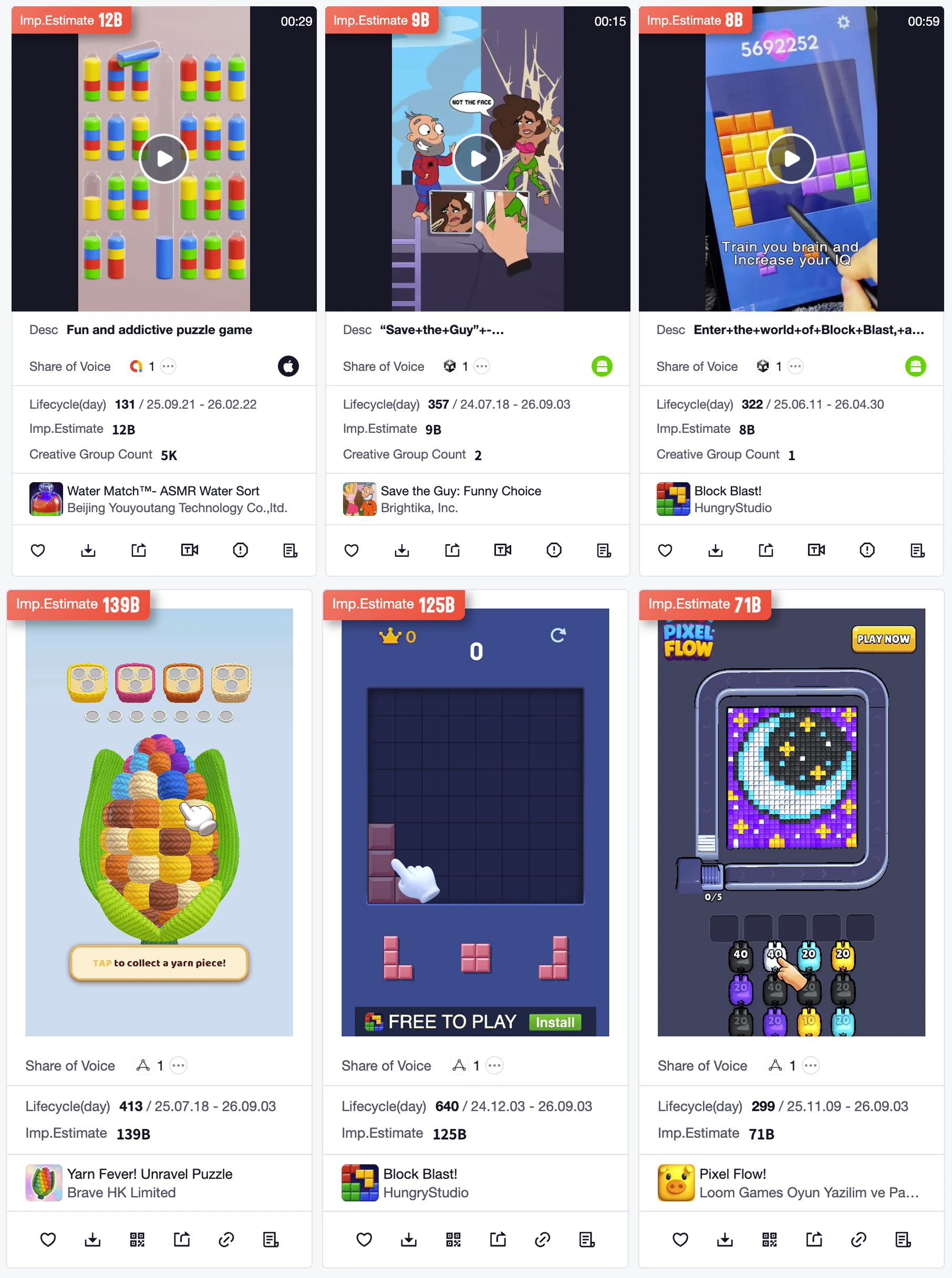
- Creative Group: An Ad Insights feature that combines all creative elements of a single campaign (video, image, playable, end card, landing page) into a unified view. Useful for studying how top studios sequence their creative assets across formats.
Creative strategy and workflow
- Hook: The opening seconds of a video ad. The point at which the user decides whether to keep watching or scroll past. Consistently identified as the highest-leverage part of any mobile video creative.
- Call to action (CTA): The prompt asking the user to take an action, usually "install now," "play free," or a variant. CTA placement, wording, and timing are all commonly A/B tested.
- Creative pipeline: The end-to-end workflow of concepting, producing, testing, and iterating on ad creatives. Often used to describe both the process and the specific team or tooling responsible for it.
- Creative production: The specific step of building the ad, usually by a design or video team, from a brief. Distinct from creative strategy (the plan for what to build) and creative testing (measuring performance).
- Creative testing: The controlled measurement of creative variants against each other, typically through A/B or multivariate tests, to identify winners.
- Creative refresh: The process of replacing creative variants that have started to underperform, either because they've been in market too long or because seasonal relevance has shifted. Sometimes called creative rotation.
- Creative fatigue: The performance decay that happens when the same creative runs to the same audience for too long. Impressions keep costing the same, but conversions drop.
- Creative at scale: The ability to produce, ship, and manage a high volume of creative variants continuously. A capability increasingly required in modern UA where refresh cycles are shorter and creative differentiation is the primary lever.
- Ad iteration: A small variant of an existing ad that changes one element (hook, CTA, colors, audio). Sits between "the same creative" and "a new creative."
- Creative brief: The document a UA or creative director sends to a production team, setting out what a new creative needs to be, look like, and achieve. Grounded creative briefs come from creative intelligence work, not internal brainstorming alone.
Ad networks and distribution
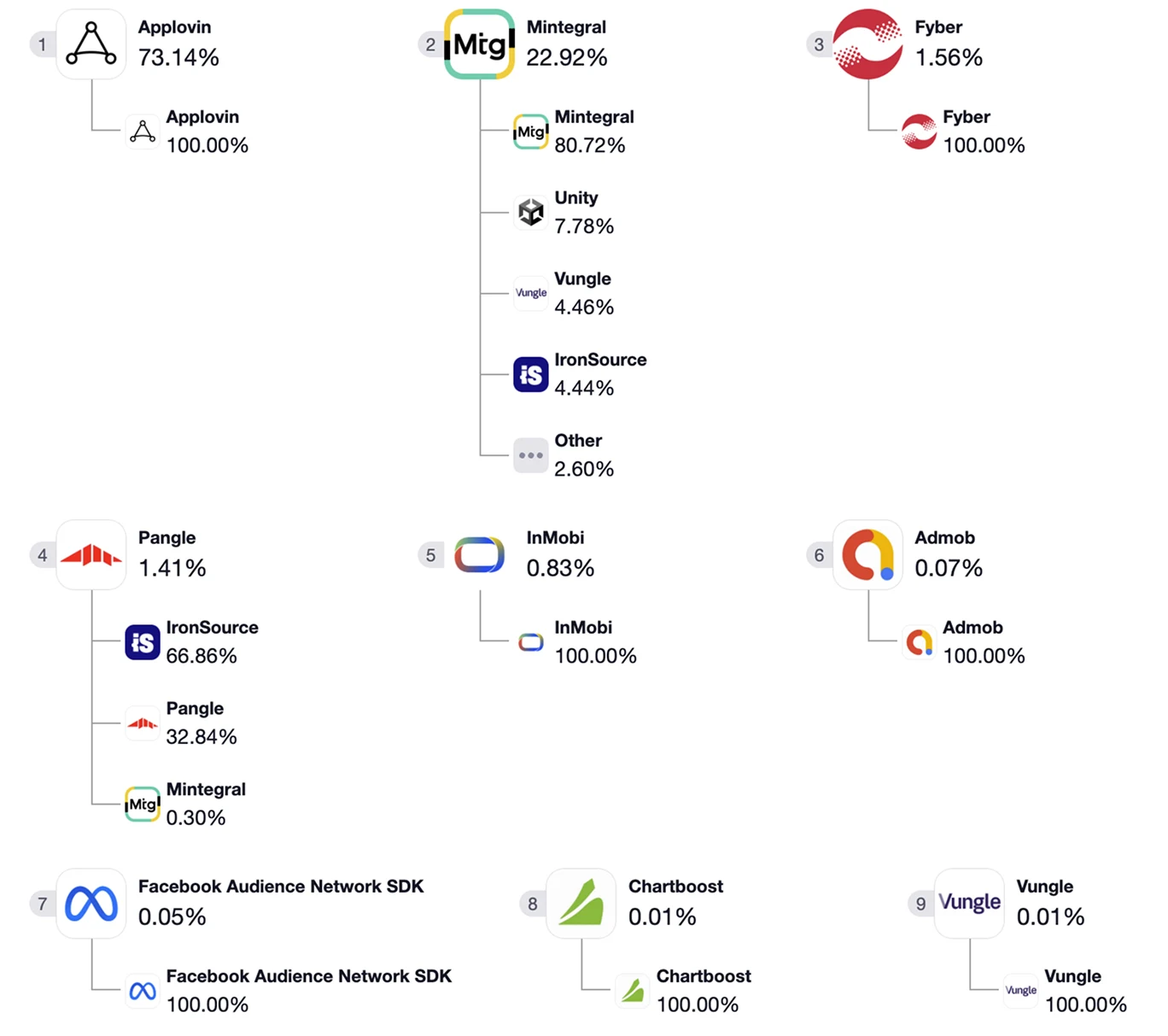
- Ad network: A platform that connects advertisers (like game studios) with the publishers whose apps show ads. Major mobile ad networks include Meta Ads, TikTok Ads, Google Ads (formerly UAC), AppLovin, Unity Ads, ironSource, Mintegral, and Moloco, among others.
- Ad exchange: A programmatic marketplace where multiple ad networks and demand-side platforms (DSPs) compete for ad impressions in real time.
- Demand-side platform (DSP): A platform that lets advertisers buy ad inventory across multiple ad exchanges and networks through a single interface.
- Supply-side platform (SSP): The counterpart to a DSP, used by publishers to manage and sell their ad inventory across multiple exchanges.
- Mediation: The system that decides which ad network shows each impression in a publisher's app, usually to maximize revenue. Common mediators include AppLovin MAX, LevelPlay (ironSource), and Google AdMob.
- Waterfall: The traditional mediation model where ad networks are queried in a fixed order until one fills the impression. Largely being replaced by header bidding.
- Header bidding (in-app bidding): A parallel auction model where all networks bid simultaneously for each impression. Generally higher yield than a waterfall.
- Ad distribution: How a game's ad campaigns are spread across networks, formats, regions, and audiences. Ad Insights' ad distribution features surface this for any competitor.
- Ad placement: The specific location where an ad appears (main menu, level end, rewarded video slot, etc.).
User acquisition (UA) metrics
- User acquisition (UA): The process of getting new users to install and use a game. In mobile, almost always paid via ad campaigns across networks.
- Cost per install (CPI): The average cost to acquire one new install through a campaign. Calculated by dividing total ad spend by total installs.
- Cost per action (CPA): The average cost to drive a specific downstream action (tutorial completion, first purchase, day-7 retention, etc.).
- Return on ad spend (ROAS): The revenue generated by a campaign divided by its ad spend. Usually measured at specific windows: D7 ROAS, D30 ROAS, D90 ROAS.
- Payback period: The time it takes for the revenue from acquired users to equal the cost of acquiring them. A key metric for evaluating campaign sustainability.
- Lifetime value (LTV): The total revenue a single user is expected to generate over their entire relationship with the game.
- Predicted LTV (pLTV): An early estimate of LTV, usually based on the first few days or weeks of user behavior. Enables faster UA decisions than waiting for actual long-term LTV to play out.
- Daily active users (DAU): The number of unique users who play the game on a given day.
- Monthly active users (MAU): The number of unique users who play the game in a 30-day window.
- ARPDAU: Average revenue per daily active user. Usually calculated by dividing daily revenue by DAU.
- ARPU: Average revenue per user across a defined period.
- ARPPU: Average revenue per paying user. A subset of ARPU focused only on users who have made at least one purchase.
- Retention rate: The percentage of users who return to the game after installing. Usually measured at Day 1 (D1), Day 7 (D7), and Day 30 (D30).
- Churn: The rate at which users stop playing the game.
- Share of voice (SoV): The percentage of total ad impressions in a category or market that a specific game or studio holds. A proxy for advertising dominance.
- Impression estimate: The estimated number of times a specific ad was viewed. Ad intelligence tools produce these through modeling, not direct measurement.
Attribution and privacy
- Attribution: The process of assigning credit for an install or event to the ad campaign that drove it. Increasingly complex in post-IDFA environments.
- Mobile measurement partner (MMP): A third-party service that handles attribution across ad networks. Common MMPs include AppsFlyer, Adjust, Singular, Airbridge, and Kochava.
- IDFA (Identifier for Advertisers): Apple's device-level advertising identifier. Post iOS 14.5, users must explicitly opt in for apps to access it. Opt-in rates are typically low, which has reshaped iOS UA measurement.
- GAID (Google Advertising ID): Google's equivalent to IDFA on Android. Google has announced plans to phase this out in favor of Privacy Sandbox APIs.
- SKAdNetwork (SKAN): Apple's privacy-preserving attribution framework. Provides aggregated campaign data without revealing user-level identifiers.
- Privacy Sandbox: Google's initiative to replace GAID-based attribution with privacy-preserving alternatives on Android.
- Deterministic attribution: Attribution based on definitive identifiers (like IDFA or GAID) linking an ad view to an install.
- Probabilistic attribution: Attribution based on statistical modeling using signals like IP address, device type, and timing. Less accurate than deterministic, but more resilient to privacy changes.
- View-through attribution (VTA): Attribution credit given when a user saw an ad but didn't click it, and later installed the app. Contentious because it credits impressions that may or may not have driven the install.
Monetization
- In-app purchase (IAP): Revenue generated by users buying items or content inside the game.
- In-app advertising (IAA): Revenue generated by showing ads to users inside the game.
- Hybrid monetization: A model that combines IAP and IAA in the same game. Most modern mobile games run hybrid.
- Impression-level ad revenue (ILRD): A monetization data feed that reports revenue for each individual ad impression. Enables much more granular monetization analysis than aggregated daily reporting.
- Direct-to-consumer (D2C): A monetization channel where studios sell directly to players outside the app stores, usually through a webshop.
- Webshop: A studio-run online storefront where players can buy in-game items outside the app store, avoiding platform fees.
- Whale: A high-spending player who accounts for a disproportionate share of a game's revenue.
- Free-to-play (F2P): A game business model where the base game is free and revenue comes from IAP, IAA, or both.
- Subscription: A recurring-revenue model where players pay a regular fee for content, features, or removal of ads.
Market and competitive analysis
- Store listing: The presentation of a game on the App Store or Google Play. Includes screenshots, description, icon, category, and metadata. Modern ad intelligence platforms track how competitors change these over time.
- App Store Optimization (ASO): The practice of optimizing a store listing to improve organic discovery and conversion rate.
- Top charts: The rankings of top-performing games on app stores, usually by category, region, and platform (iOS/Android).
- Category ranking: A game's position within a specific app store category (Puzzle, RPG, Casino, etc.).
- Similar audience apps: Games or apps that share meaningful audience overlap with a target game. A powerful discovery tool for identifying non-obvious competitors and creative inspiration.
- Genre: A classification of games by gameplay type (match-3, RPG, casino, hyper-casual, hybrid-casual, etc.). Often the primary axis for creative benchmarking.
- Hyper-casual: A category of simple, ad-monetized games with short session times, minimal onboarding, and high install volume.
- Hybrid-casual: A category that blends hyper-casual accessibility with mid-core mechanics and hybrid monetization. Now one of the dominant mobile categories.
- Portfolio-level analysis: Looking at a studio's overall performance across all its games rather than individual game-level rankings. Often reveals different market dynamics than single-game data.
Tooling and infrastructure
- SDK (Software Development Kit): A code library that a studio integrates into a game to enable specific functionality. Common categories: analytics SDKs, ad network SDKs, MMP SDKs, monetization SDKs.
- Analytics platform: A tool that captures, processes, and reports on player behavior data from a game. GameAnalytics is one example.
- Ad intelligence platform: A tool that captures, aggregates, and reports on ad activity across the market. Ad Insights is one example.
- Creative gallery: A searchable library of ad creatives from across the mobile advertising market. The core interface of most creative intelligence tools.
- Image and video search: An Ad Insights capability that lets you upload a screenshot or clip of a competitor ad and find matching or visually similar creatives.
- Store listing change tracker: A capability that monitors when a competitor updates their store listing, capturing before-and-after comparisons of screenshots, descriptions, categories, and downloads.
This glossary is the vocabulary. Ad Insights is the tool most of these definitions map to in practice. If you'd like to see how ad libraries, creative filtering, playable analysis, store listing tracking, and audience overlap all come together in a single workflow, start a free trial or explore the Ad Insights features documentation.