Do you need a game data analyst? And what parts can be automated

min read
Regardless of what your role is, it’s likely you’ve recently asked yourself whether AI could replace you or how your work will change.
For game data analysts, the question seems especially pointed. Most of the day-to-day work has become something an AI agent can do in minutes. And surely all the LinkedIn posts, the layoffs at mid-size data teams, the headlines about AI replacing 80% of analyst work can act as stressors for anyone whose role's been rapidly automated lately. (Luckily) for Data Analysts, AI is coming for the technical layer of the job. A recent piece from Databricks frames it well:
AI isn’t ending the analyst role; it’s restoring it to what it should have been all along.
Game data analysts were never supposed to spend their weeks running ad hoc SQL for one-off requests from the LiveOps team, rebuilding the same cohort view every time a new producer joined the project, and wrestling with raw event streams that nobody had properly modeled. They were supposed to translate questions about player behavior into decisions about the game. The mechanics of execution just got in the way, and luckily that’s the part getting automated the most.
The article puts it like this:
The analyst who only does those things is being automated. The analyst who frames business problems and drives decisions is becoming more and more valuable.
It might feel like a good chunk of your day is being handed to machines, but there’s plenty left for analysts in a studio, and it gives you the freedom to focus your expertise where it matters most. So if anything, the job is sharpening, and deciding what matters for the game is still a human call.
Agents are good at answering questions, but not at knowing which question to ask next about your game, your player base, your current live event, or your upcoming release. That’s the kind of judgment, product context, and studio sense that only a human can bring to the table. And equally, validating whether an insight means anything still requires a human filter. AI will confidently report correlations that are noise, artifacts of selection bias in your cohort definitions, or statistical flukes from a tiny sample during a limited-time event. And it's up to you to decide whether the pattern is real. In the coming weeks, I’ll write about why AI gives confident but wrong answers and what steps you can take to prevent this. Keep an eye on our blog so you don’t miss it.
If you’re still looking for more, think about pushing back on data requests that could mislead the team. You’re surely familiar with passionate discussions about what a metric represents and how it should be interpreted. An agent can build the retention chart your CEO asked for, but your role is to flag that the chart answers the wrong question and to suggest the right methodology. The ownership of metric definitions remains yours, and when those definitions drift (which they will, as new mechanics ship and old metrics stop meaning what they used to), someone needs to catch it before the next board update is built on numbers that look right but aren’t.
And finally, qualitative context from outside the data is almost entirely human. Think App Store policy changes affecting reward video placement, or a competitor shipping a feature that pulled your audience’s attention for two weeks. The warehouse doesn’t know about any of that, but you (ideally) do.
This thread, which went around a few weeks ago, captures the practical version of my point and the role's shift well:
A visualization from the Databricks piece makes the layered version of this concrete:
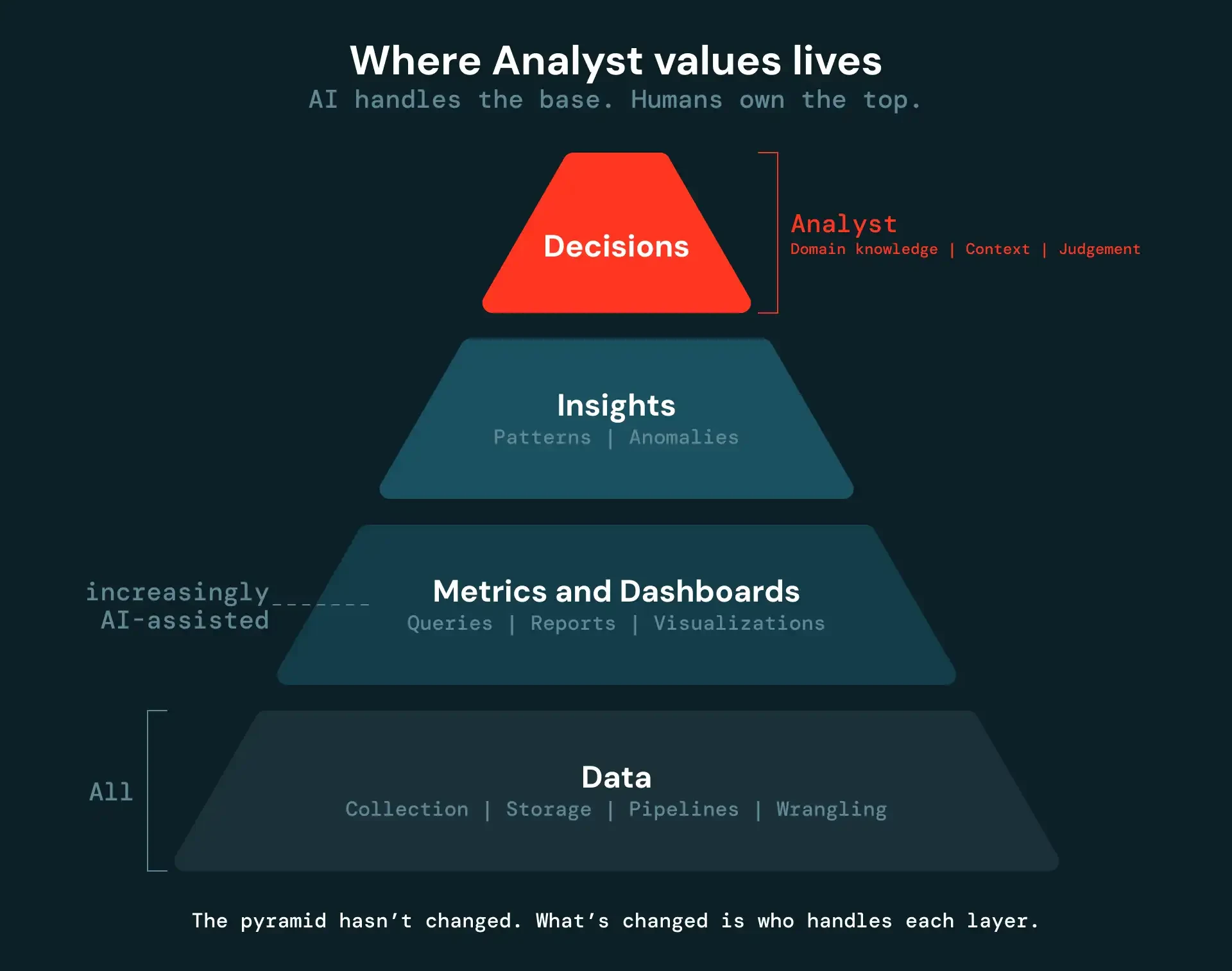
The pyramid has always looked like this. The difference is in who handles which layer. AI is taking over data collection, storage, pipelines, and wrangling, and it’s increasingly handling metrics, queries, reports, and visualizations. What’s left for the analyst sits at the top: spotting patterns and anomalies, applying context, passing judgment, and making decisions.
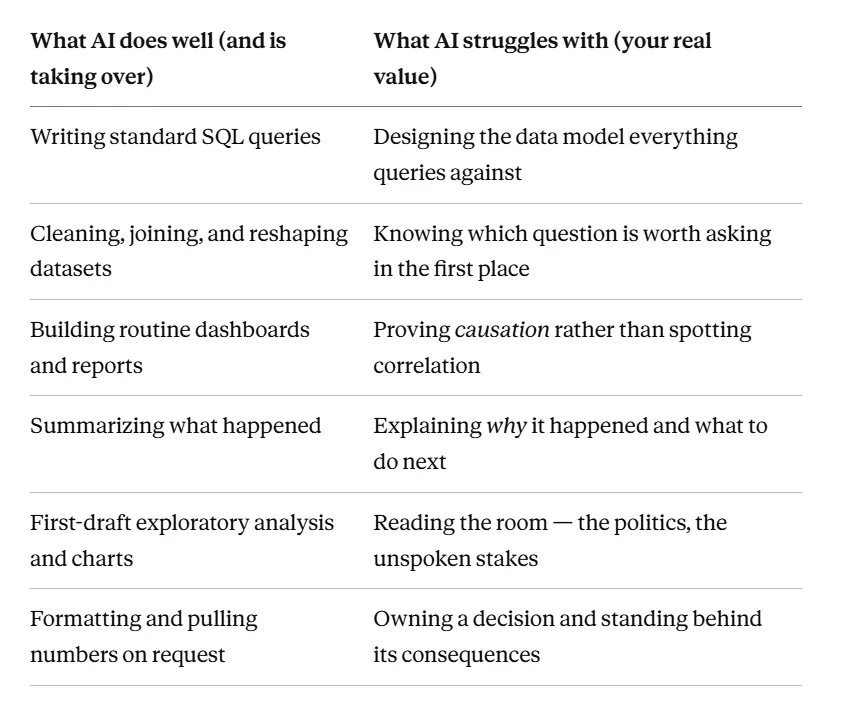
As more of the technical work gets automated and the commodity part of the job disappears, analysts are becoming the logic layer of the game team. Mostly because business logic and institutional knowledge (how your studio operates, what your audience responds to, what your LiveOps cadence demands) is still difficult for AI to capture. Look at the right-hand column in this breakdown from Weng Honn’s Substack and noticewhat AI struggles with. The items aren’t technical; they’re judgment-heavy and human.
This same shift is captured in Olga Berezovsky’s piece on the Data Analysis Journal, where she smartly outlines three distinct eras for the analytics function:
2015: Reporting → 2020: Optimization → 2026: Decision
- Reporting era: the data team’s job was to explain what already happened. Success meant accuracy, consistency, and speed.
- Optimization era: the job shifted to improving outcomes. Success meant moving conversion, retention, and LTV (and now your data team knows what it means) and building experimentation muscle to do it reliably.
- Decision infrastructure era: the job becomes powering decisions for both humans and AI. Success is measured by the number of decisions you can make that are fast, causal, and safe to automate.
Applied to a game studio, this is the shift from “the analyst tells us what the retention curve looked like last month” to “the analyst designs the experimentation framework that lets us ship a new onboarding every two weeks and know within four days whether to keep it.” That’s a different scope, value, and kind of role from what most studios are used to. Analysts are becoming curators, and more accountable for the decisions that follow from their work, which changes the perception of their role. The goal, once AI data workflows are in place, is prioritizing interpretation over execution, governing the agents that LiveOps teams and producers interact with directly, and orchestrating insights across game teams.
I think this post from Ethan Aaron, one of the GOATs when it comes to anything data-related (IMO), summarizes well where the role is heading and how data analysts can stay future-ready:
If you zoom out from the day-to-day debates and try to assess the role’s stickiness, the labor market data is quite reassuring (at least for now). In March 2026, Anthropic published a report called ‘Labor market impacts of AI: A new measure and early evidence’ looking at which roles are most exposed to AI replacement. The most-exposed occupations table is worth reading closely:
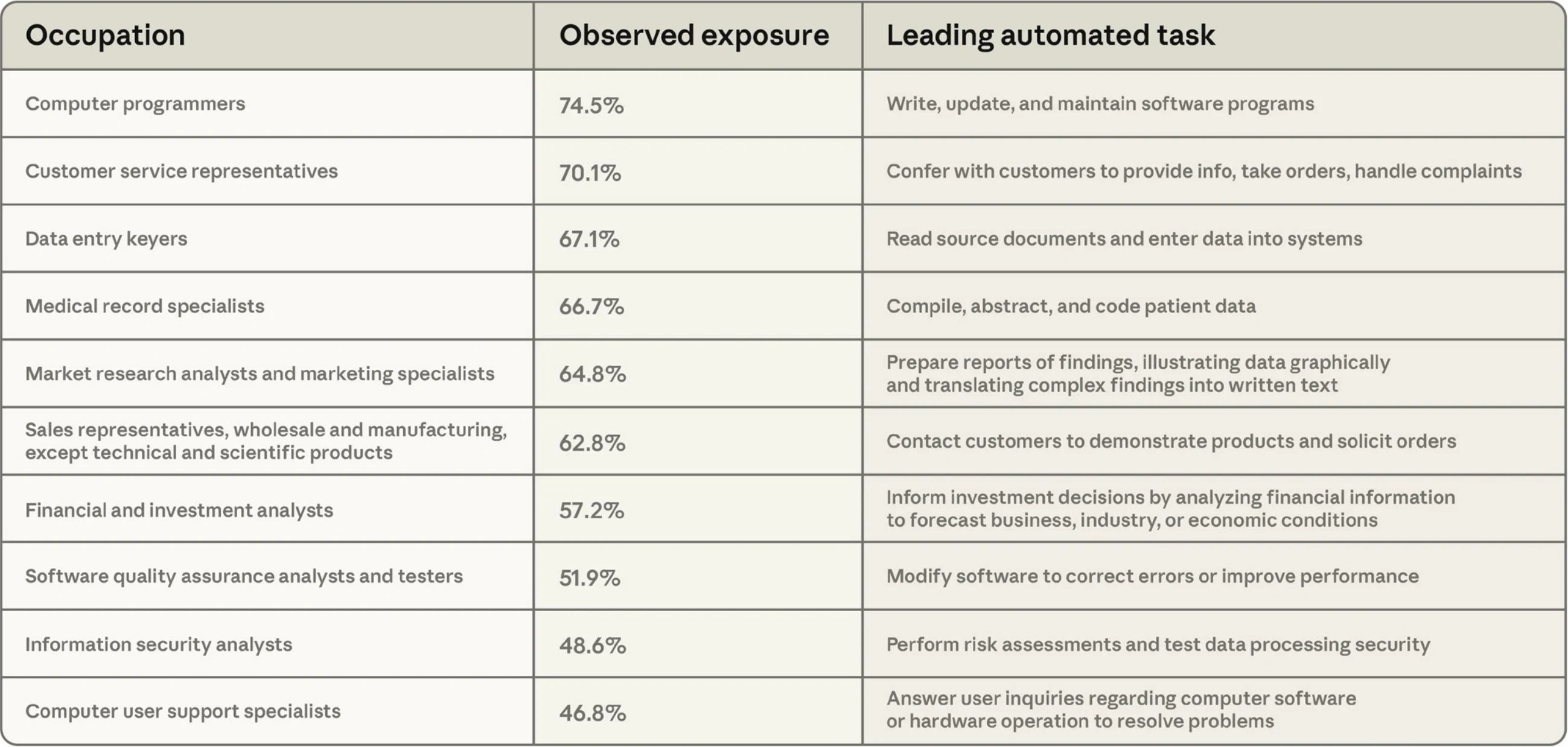
Data entry keyers are the only role that shows up among endangered data-related positions, and that role is fundamentally about typing information from one system into another, categorically different from a (game) data analyst, whose job is interpreting player behavior and shaping product and LiveOps decisions. Market research analysts and marketing specialists appear at 64.8%, but even that reflects AI handling the preparation and formatting layer, not the judgment layer.
And the World Economic Forum’s Future of Jobs Report 2025 echoes this by naming Data Entry Clerks among the fastest-declining roles through 2030, while technology-related roles including Big Data Specialists are among the fastest-growing in percentage terms. Hurray for the consistent pattern: data entry gets automated, data judgment gets amplified.
If you’re a studio lead reading this and wondering whether you still need a game data analyst in the big 2026, the answer is still yes. But probably not for the reasons you’d have hired one a few years ago. Screen for analysts who can define a metric and defend it, frame a product question before touching the data, and change their mind when the evidence contradicts them. The SQL you can teach. Or, more accurately, you can let the AI handle it, and spend the training time on everything else that moves the needle and makes your game better