What is creative intelligence for mobile user acquisition? A complete guide

min read

What is creative intelligence for mobile user acquisition, and how does it work? A complete guide to what it surfaces, why it matters, and how UA and creative teams put it to work.
If you've spent any time optimizing user acquisition in mobile gaming, you already know the answer to the biggest question: why do some studios keep winning while others plateau? It rarely comes down to the network, the targeting, or the budget. It comes down to the creative.
A stronger ad hooks the right player faster, converts higher, and reduces the pressure on every other lever in your funnel. A weaker ad forces you to spend more, target broader, and refresh more often to keep results afloat. Creative is the single biggest lever in mobile UA, and creative intelligence is how you pull it.
This guide covers what creative intelligence is, why it's become mission-critical for mobile studios, and how the best UA and creative teams put it to work.
What is creative intelligence?
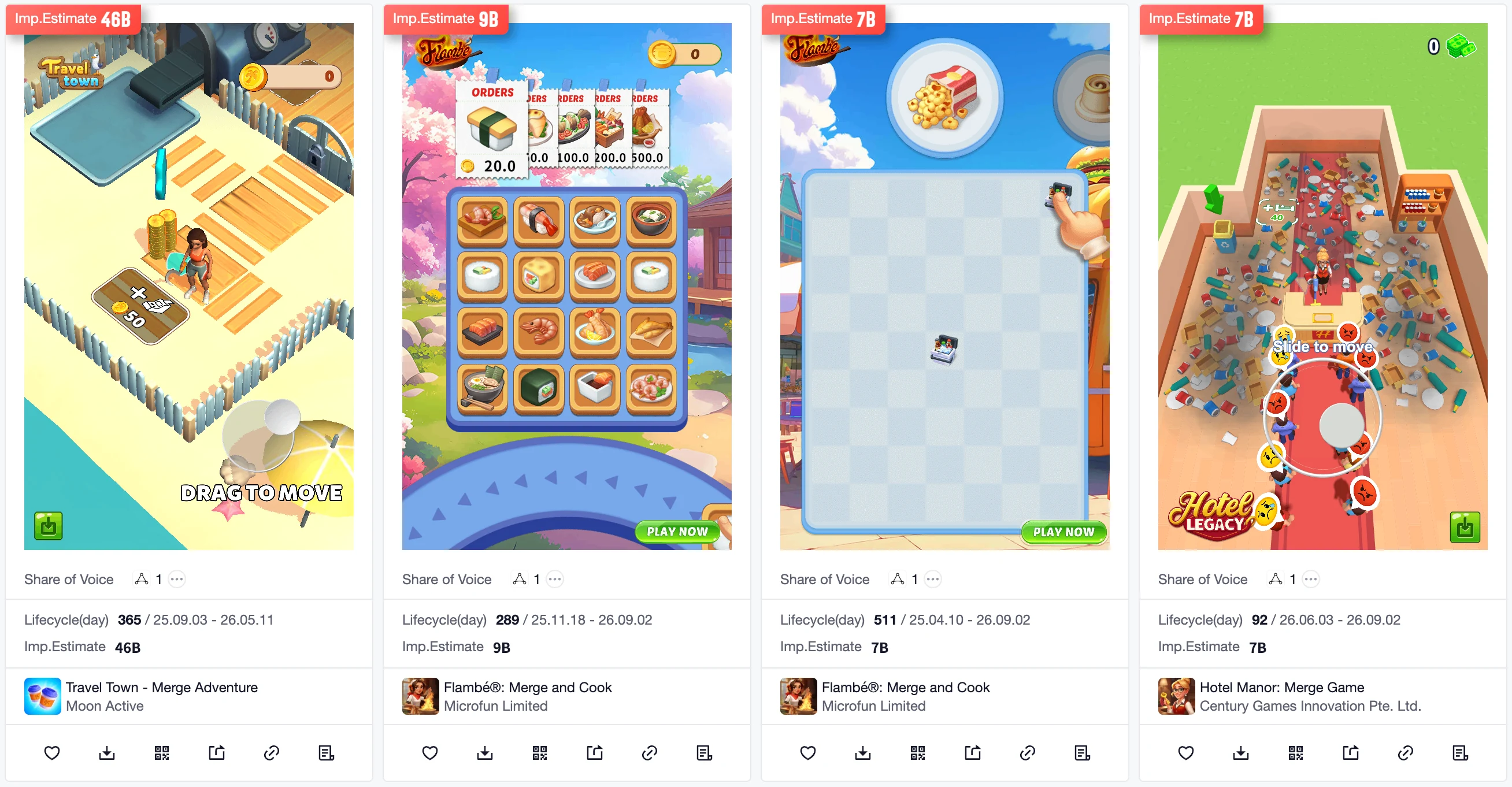
Creative intelligence is the practice of studying advertising creatives at scale, in market, in order to understand what's working and why. Instead of guessing which formats, hooks, or visual patterns are driving results, you look at real ads running right now across the games in your genre, analyze how they perform, and extract patterns you can apply to your own campaigns.
It's a subset of the broader ad intelligence category, which covers everything from spend estimation to network targeting to campaign structure. Creative intelligence zooms in specifically on the creative asset itself: the video, the playable, the image, the sequencing, the hook, the CTA, the emotional beat.
The best creative intelligence tools don't just show you ads. They let you filter by genre, format, network, region, audience, and performance signal, so you can surface the specific creatives that map to your game and your market. From there, the work is pattern recognition: what do the top performers in your genre have in common? Where are they diverging? Which patterns are emerging? Which are declining?
Answering those questions used to require a large in-house creative research team. Today, tools like Ad Insights put the same capability within reach for studios of any size.
How does creative intelligence actually work?
At its core, creative intelligence works by continuously scanning the mobile advertising ecosystem, capturing the ads running across it, and turning that raw stream into a searchable, filterable library that UA and creative teams can act on.
- Ad discovery: Creative intelligence platforms continuously monitor mobile ad networks and public advertising activity across dozens of platforms. When a new creative goes live, it gets captured, tagged, and added to the searchable library, usually within hours of it going live in market.
- Enrichment and tagging: Each captured creative gets enriched with structured metadata such as the advertising game, the studio, the ad network, the countries it's running in, the format (video, playable, image), the CTA, the campaign goal, and the estimated impressions. The best platforms also extract deeper data: video length, hook style, on-screen copy, visual patterns.
- Search, filter, and analyze: The library becomes queryable. UA and creative teams can filter creatives by genre, format, network, region, audience, growth signal, or engagement metrics like reposts and comments. The stronger the filtering, the faster the pattern recognition.
- Pattern recognition: With the right filters applied, patterns emerge fast. Which hooks are winning in casual puzzle right now? Which formats are converting best in Germany? Which studios have started running playables in the past 30 days? These are the questions a good creative intelligence workflow answers in minutes, not weeks.
- Alerting and monitoring: The best platforms let you follow specific games, studios, or genres, so you get notified when new creatives launch, when campaigns shift, or when a competitor moves. This turns creative intelligence from a periodic research activity into a continuous signal.
Together, this end-to-end pipeline is what turns "billions of ads across dozens of networks" into "here are the three creatives your closest competitor launched this week, ranked by impression volume, with the ones your team should study most closely at the top."
Why creative is the biggest lever in mobile UA
Mobile UA has three major levers: targeting, bidding, and creative. Ask any experienced growth marketer which of the three moves the needle most, and they'll tell you the same thing. Targeting and bidding are increasingly automated, algorithmically optimized, and standardized across networks. Creative is the one variable that's still fully in your control, and it's the one variable where the difference between top-quartile and median performance can be several multiples, not percentage points.
A few data-backed reasons this matters more than ever:
- iOS 14+ and the death of granular targeting made creative the primary signal networks use to find your audience. A stronger ad now trains the algorithm faster and reaches better users.
- Rising CPMs and CPIs across every major network mean the cost of running a weak creative is going up, not down. A poor-performing ad doesn't just underperform, it actively burns budget you could be spending on winners.
- Creative fatigue is accelerating. The volume of ads in market, combined with shrinking attention windows, means creatives fade faster than they did five years ago. Refresh cycles are shorter, and the teams that can produce winning concepts consistently have a structural advantage.
- Attention is the scarcest resource in mobile. Players see hundreds of ads a day. The first three seconds of your creative decide whether it lands or scrolls past.
The studios winning at UA right now share one habit: they treat creative research as ongoing work, not a one-off project at the start of a campaign. They study the market constantly, learn from what's outperforming, and turn those learnings into briefs their production teams can act on quickly.
That habit is what creative intelligence enables.
What creative intelligence actually shows you
Creative intelligence covers several distinct capabilities. The strongest tools combine most of them into a single workflow.
- Creative search and filtering: The foundation of any creative intelligence tool. Search for ads by game, studio, genre, format, network, region, date range, or free-text keyword. Filter by monetization model (IAP, IAA, or both), by audience demographics, by engagement metrics like reposts and comments, or by growth signals like fast-rising impression counts.
- Playable ad libraries: Playables are one of the highest-converting mobile ad formats, and one of the hardest to produce well. The best creative intelligence tools give you access to interactive libraries of playables running in market, so your team can study the mechanics, difficulty curves, and CTA timing that top studios use.
- Creative sequencing and campaign structure: How top studios sequence their creatives across formats (video first, then playable? image, then rewarded ad?) is often the difference between a winning campaign and a losing one. Creative intelligence tools that surface these patterns give you a strategic view most in-house creative teams can't build on their own.
- Similar-title and audience overlap analysis: When you know a competitor is winning with a specific creative, being able to see what other games and apps their audience is engaging with opens up new competitive intelligence entirely. This is where creative intelligence starts overlapping with broader ad intelligence.
- Image and video search: When you've spotted a compelling creative in the wild but don't know the studio behind it, image or video search lets you upload the asset and find matching or visually similar creatives across the tool's library. This is one of the newer capabilities in creative intelligence and one of the most powerful for research teams.
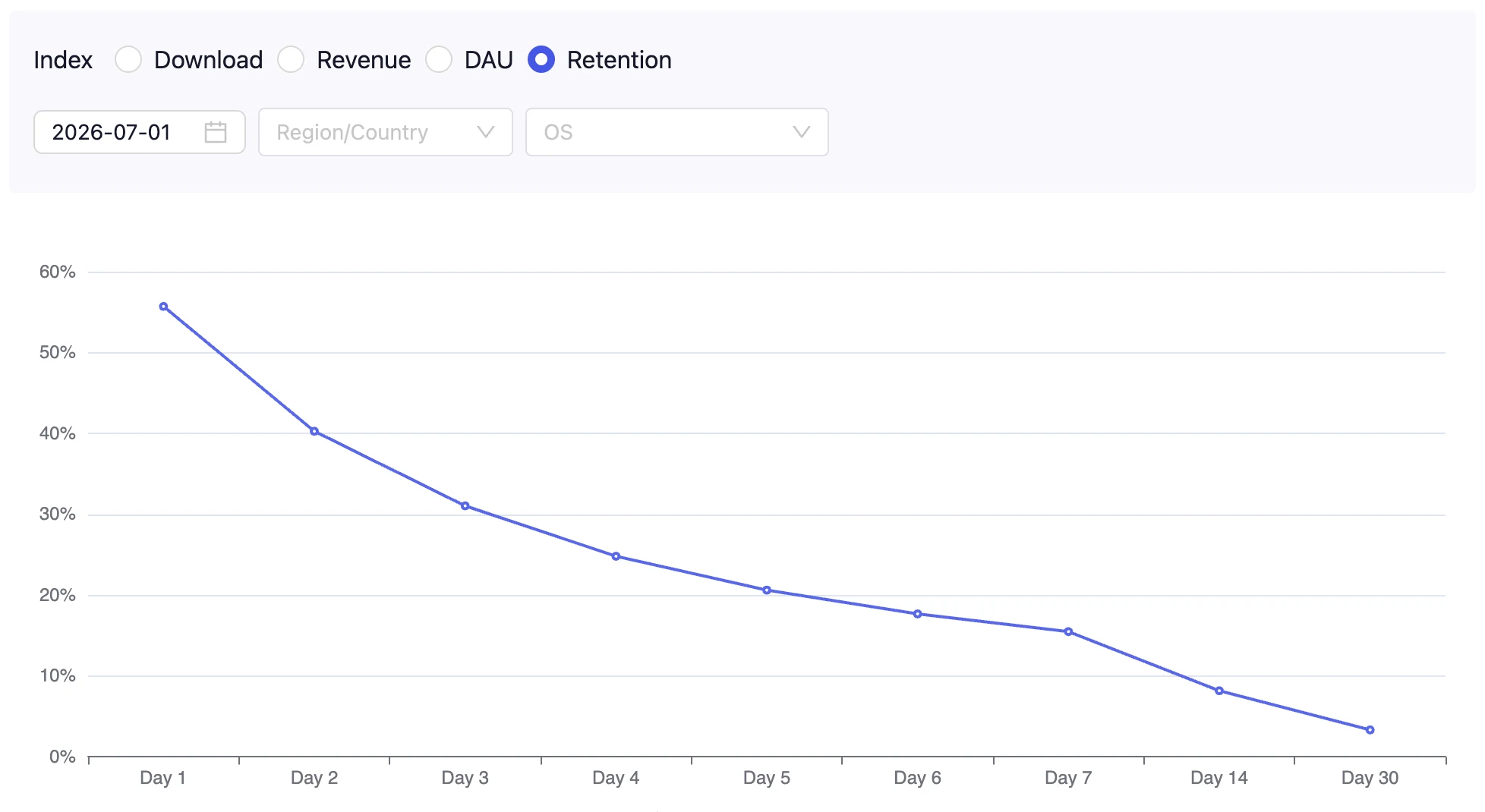
- Performance signal: Impression estimates, engagement metrics, audience demographics, and growth analysis let you separate the top performers from the noise. Not every ad in a creative library is worth studying, and the tools that surface performance signal make research meaningfully faster.
See the Ad Insights features documentation for how these capabilities work inside a live tool.
Creative testing, refresh, and the production pipeline
Creative intelligence isn't a replacement for creative testing or a substitute for a production pipeline. It's the layer that makes both work better.
For creative testing, creative intelligence gives you sharper hypotheses to test. Instead of running twenty variants because you don't know what will work, you can look at what's already working in market for similar games and run five variants of the strongest patterns. The hit rate goes up, and the wasted spend goes down.
For creative refresh, creative intelligence tells you when to move. Watching what competitors are launching and how their creatives are performing gives you a working sense of when a category is shifting, so you can time your own refreshes to real market movement rather than to internal instinct. This is the specific link between creative intelligence and refresh cadence.
For your production pipeline, creative intelligence closes the loop between market signal and brief. Instead of your production team building from scratch every time, they can build against a pattern you've already validated exists in market. Briefs get more specific, iterations get faster, and the pipeline compounds instead of restarting.
For creative at scale, this is the underlying enabler. Studios that want to ship high volumes of creative variants continuously can't do it if every variant is a new invention. Creative intelligence makes it possible to iterate on validated patterns, which is the only sustainable way to produce creative at real UA scale.
The teams that treat creative intelligence as an input into testing, refresh, and production, rather than as an occasional research exercise, are the ones getting compounding returns from it.
How UA and creative teams put it to work
Creative intelligence isn't a single workflow. It shows up in different parts of the marketing team in different ways.
For UA managers, creative intelligence closes the loop between "what should we brief" and "what's actually working in market." Instead of relying on internal creative instincts alone, UA managers can point at specific creatives running right now in their genre, extract the patterns that connect them, and hand those patterns to production teams as briefs grounded in real market signal.
For creative directors and producers, creative intelligence is a research library and a benchmarking tool. It gives them a defensible reference set for creative decisions, cuts internal debate short with real examples, and helps calibrate whether an in-house concept is genuinely differentiated or just a variation on something the rest of the market is already running.
For growth leadership, creative intelligence provides the strategic view: which studios are gaining share of voice, which formats are winning in your category, where the market is heading, and where the opportunities are. It's the layer that connects individual creative decisions to portfolio-level strategy.
For market researchers and analysts, creative intelligence intersects with broader market intelligence. Ad libraries, campaign timing, network mix, and audience demographics all provide signal about competitor strategy that no other tool captures with the same specificity.
Building a creative intelligence practice
Adopting creative intelligence as a habit doesn't require a large team or a complex process. What matters is turning it into a regular rhythm rather than a one-off project. A weekly cycle that compounds:
- Scan the top-performing creatives in your genre for anything new or fast-rising
- Study two or three that stand out, digging into their sequencing, hooks, and format choices
- Compare what your competitors are running against what you know about their spend, audience, and campaign structure
- Brief one new creative concept per week grounded in a specific pattern you've spotted
- Test and measure against your existing creative rotation
Over a quarter, that's twelve to fifteen fresh concepts grounded in market signal. That's how a creative engine gets built.
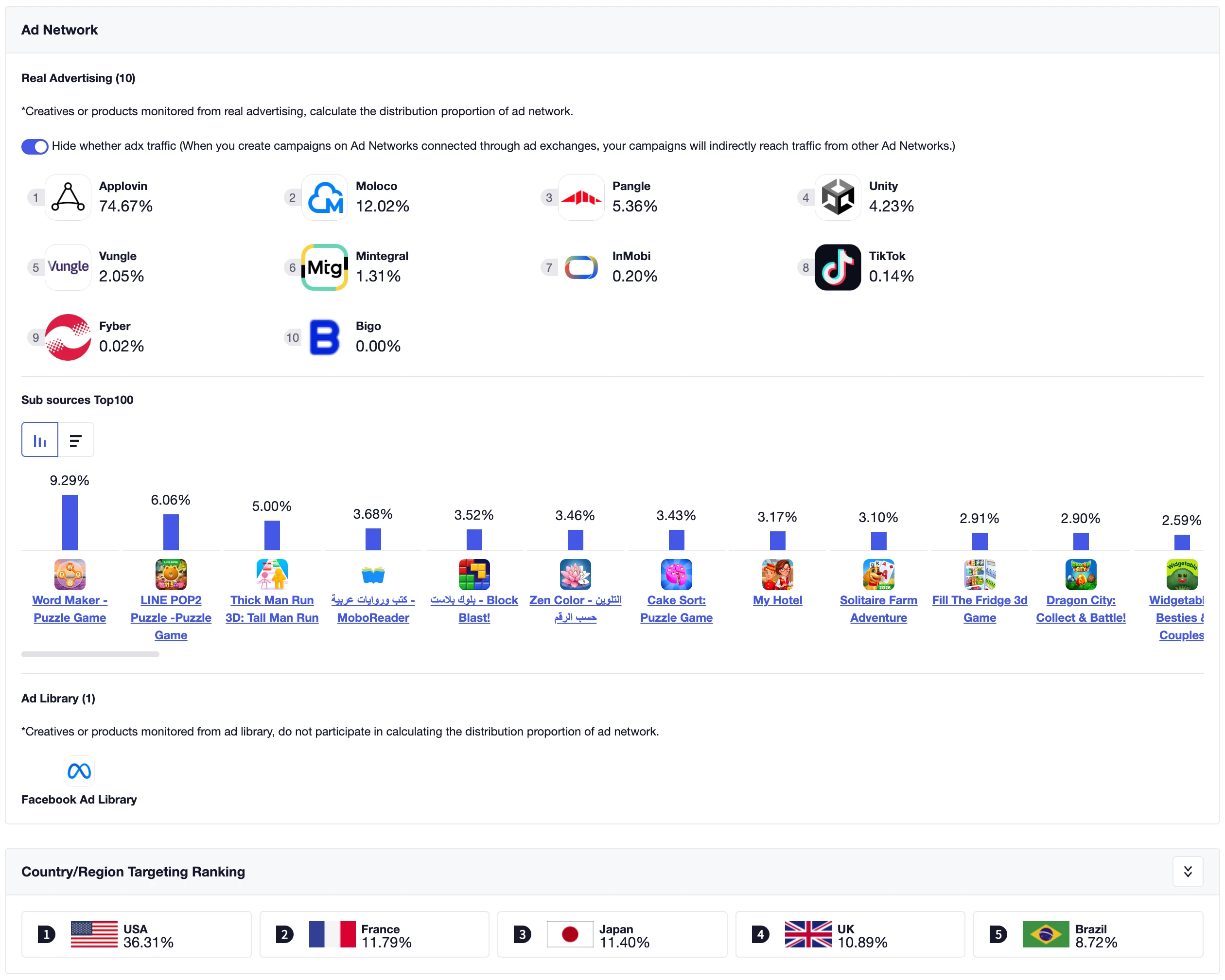
Creative intelligence in the wider ad intelligence landscape
Creative intelligence is often talked about as if it's synonymous with ad intelligence more broadly. It isn't. The two categories overlap, but they're not the same thing.
Ad intelligence covers the full breadth of what a competitor is doing to acquire users. That includes creatives, but also spend estimation, network targeting, campaign structure, audience demographics, geographic distribution, and app store performance. It's the whole picture of competitor UA.
Creative intelligence is the subset that focuses specifically on the ads themselves: what they look like, how they perform, what patterns connect the winners, and how they evolve over time.
Most studios need both. Ad intelligence tells you where a competitor is investing and how their strategy is structured. Creative intelligence tells you why their specific creatives are working, and what your team should learn from them. Tools that combine both, like Ad Insights, offer a single workflow for the full picture rather than forcing you to piece together the story across multiple products.
The bottom line
Creative is the biggest lever in mobile UA. Creative intelligence is how the best studios pull it consistently.
The teams that are winning at UA in 2026 aren't the ones with the biggest budgets. They're the ones who learn fastest from what's already working in market, and turn those learnings into a repeatable creative production cycle. Creative intelligence is the discipline that makes that possible.
If your studio is spending on user acquisition and your creative research is still ad-hoc, occasional, or entirely internal, the gap between you and the studios that treat creative research as ongoing work will keep widening. Closing that gap doesn't require a large team. It requires a habit, a workflow, and a tool that surfaces the right signal.
That's what creative intelligence is for.