Mobile game ad formats: the 5 that work in 2026

min read

The 5 mobile game ad formats that actually work in 2026. Short-form video, rewarded, playable, playable end cards, and interstitial. What to run, when, and how to research each.
The mobile game advertising ecosystem in 2026 is dominated by a small set of high-performing formats. Short-form video carries most of the spend. Playables punch far above their share. Rewarded video is the default acquisition channel for a large share of developers. And a group of formats you might still see on older ad-format lists (banners, native, offerwalls, splash) have moved out of the user acquisition conversation into monetization, where they now belong.
This guide covers the 5 mobile game ad formats that actually drive user acquisition in 2026: what each one is, when to use it, and how to research what your competitors are running with it. For the network-served formats covered below (video, rewarded, playable, playable end cards, interstitial), tools like Ad Insights let you study exactly what competitors are running in your genre right now.
The state of mobile game advertising in 2026
Before choosing which formats to run, it helps to know the three forces currently shaping performance across every one of them.
Short-form video dominates spend. Video creatives account for 74% of all mobile game ads, and short-form clips under 30 seconds make up 58% of that. If you're deciding where to invest first, this is the format most of your competitors are already testing hardest.
Creative lifespan has collapsed. In mature markets like the US, UK, and Germany, the average creative burns out in under 5 days. Teams shipping fewer than 4-6 creatives per month are losing performance to teams that ship 20-40. Format choice matters less than refresh cadence at this point.
Two production styles now shape every format. UGC-style creative (creators filming themselves reacting to gameplay in the visual language of TikTok and Reels) accumulates fatigue 30-40% slower than studio-produced ads of the same volume. Alongside it, AI-generated variations are expected to make up more than 50% of shipped creatives by the end of 2026. Neither is a format, but both apply across every format below.
The 5 dominant formats in 2026
1. Short-form video ads
The single most common format across the mobile game advertising ecosystem. Short-form videos run 6 to 30 seconds, are optimized for the first three seconds (the hook), and dominate spend on Meta, TikTok, Google, AppLovin, and Unity Ads. Meta's algorithm judges ad similarity largely based on the hook, so the opening frames do double duty: they hook the viewer and they tell the platform what audience to serve the ad to.
Best fit: every genre, every campaign type, especially for driving installs from new audiences. Casual and hyper-casual titles lean heaviest on this format; midcore and RPG games use it alongside longer-form gameplay video.
How to research it: In Ad Insights, filter the creative gallery for video creatives in your genre and region, then sort by impression estimate to see which short-form creatives are driving the most reach in the market right now. Study the opening three seconds across the top performers, and pay attention to how they use text overlays, captions, and pacing.
2. Rewarded video ads
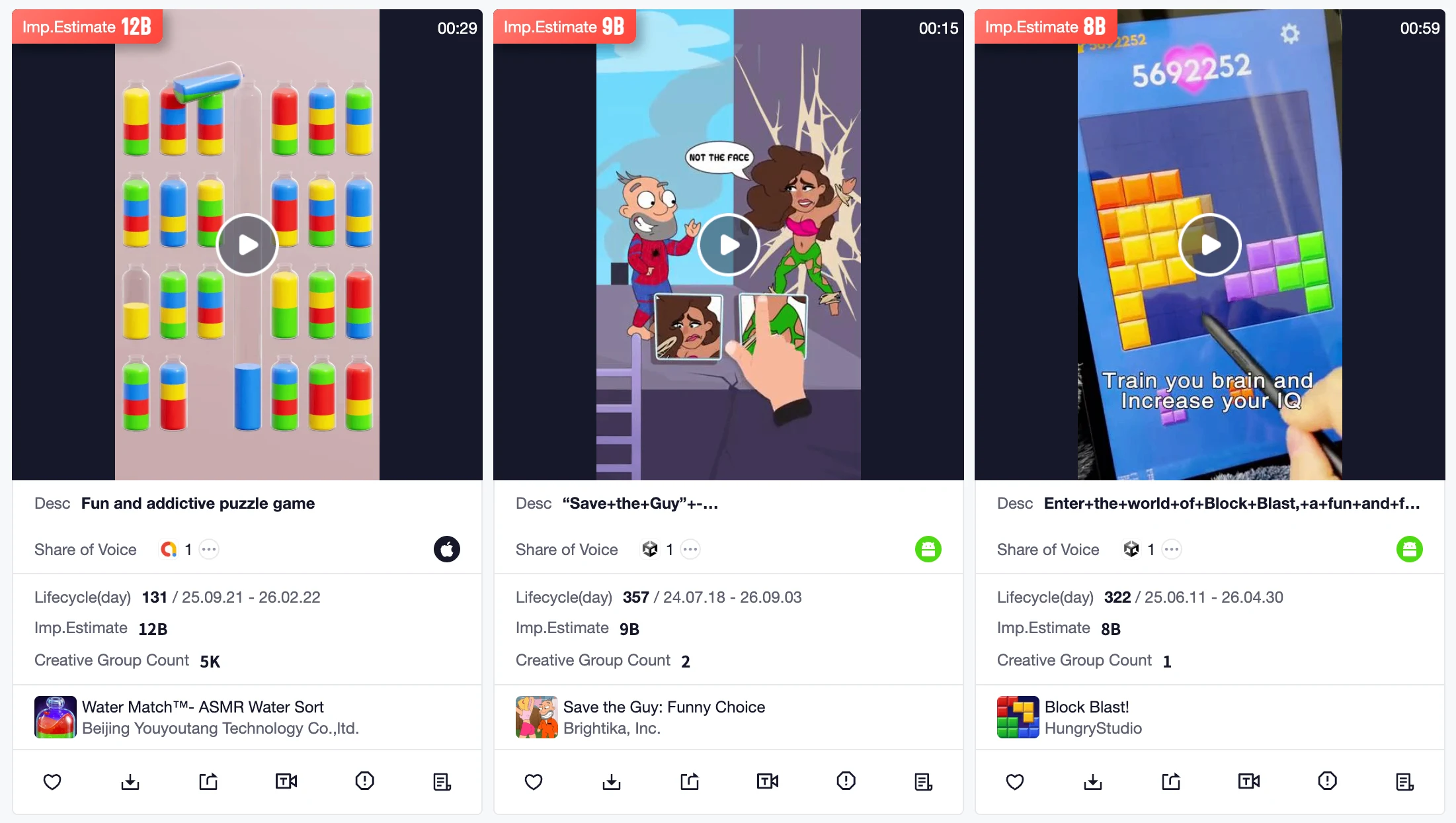
A rewarded video gives the player an in-game reward (currency, energy, extra life) in exchange for watching. Because players opt in, rewarded video consistently delivers the highest eCPM of any format, typically $10-30 CPM in top-tier markets. 82% of developers report that reward-based UA vastly outperforms traditional channels.
Best fit: in-app monetization inside hybrid-casual, casual, and mid-core titles with mid-session moments that pair naturally with a value exchange (energy refills, revive after failure, currency rewards). Also increasingly used for user acquisition through reward-based UA networks.
How to research it: In Ad Insights, filter the creative gallery by ad type = Rewarded Video Ads to see the rewarded creatives running in your genre. Compare how top studios frame the incentive on the end card, structure the CTA, and pace the video to encourage repeat viewing.
3. Playable ads
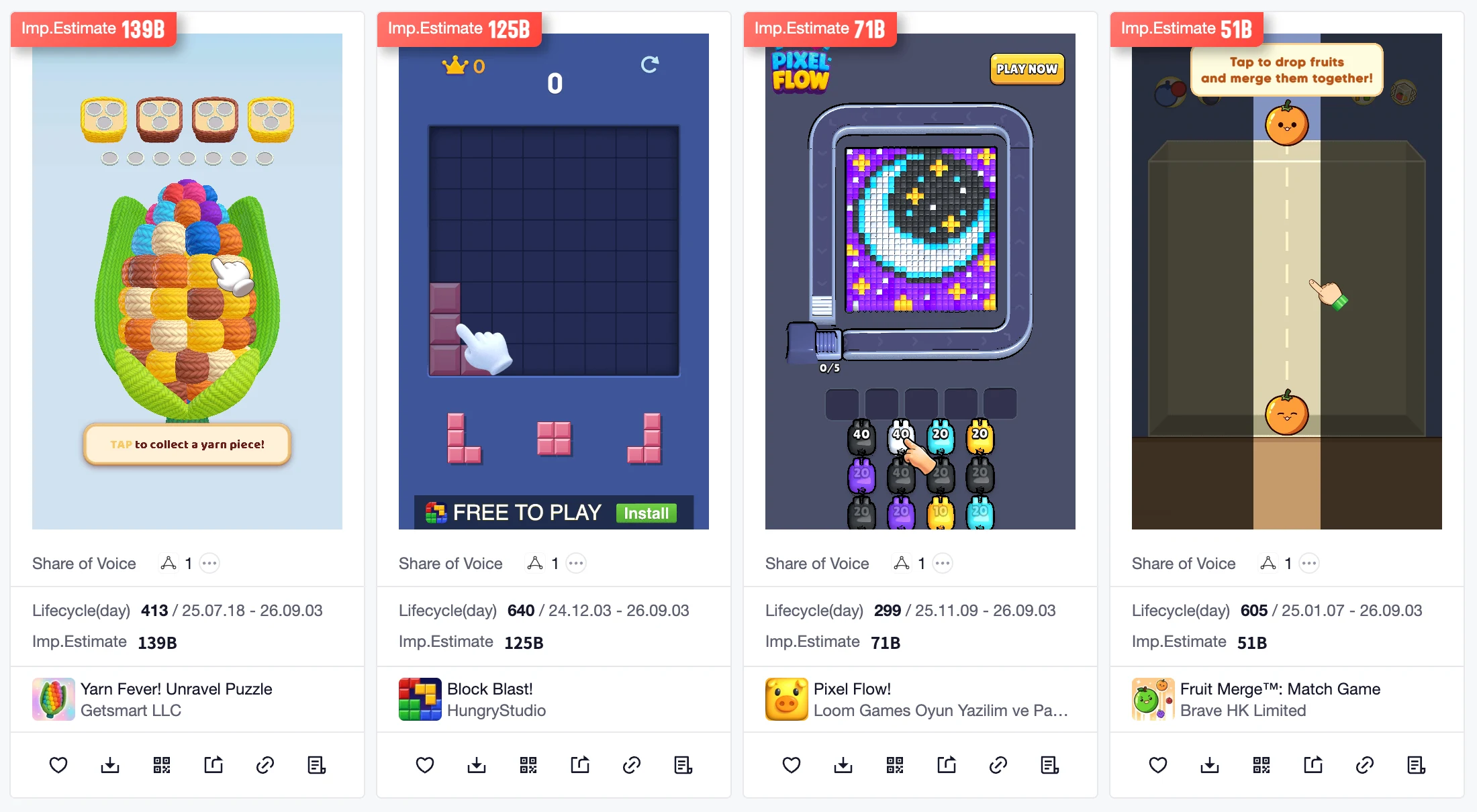
A playable ad lets users try a short version of the game inside the ad unit before installing. Higher production cost than video, but the numbers back the investment. Playables average 4.8 IPM versus 2.9 for video, and their creative lifespan is 15.4 days on average versus 9.2 days for Meta video. On AppLovin inventory specifically, playables regularly outperform video by 2-3x IPM.
Best fit: games with a mechanic that can be demonstrated in 15 to 30 seconds. Hyper-casual, hybrid-casual, and puzzle titles benefit most; complex RPGs and simulation games struggle to condense their appeal into a playable window.
How to research it: Ad Insights includes a dedicated playable ad library where you can interact with the playables your competitors are running. Study the onboarding flow, difficulty curve, and CTA timing across the top performers in your genre before briefing your own.
4. Playable end cards
A hybrid format: a standard video body followed by a 15-second interactive end card. This gives you interactive engagement at a fraction of the production cost of a full playable. Increasingly common on ironSource, Unity Ads, and AppLovin inventory as a cost-effective middle ground between plain video and full playable.
Best fit: studios that want playable-adjacent engagement without full playable production costs. Genres that struggle to fit into a playable window can still benefit from the interactive end card format.
How to research it: Ad Insights lets you view the end card of every video and playable ad in the library. Compare CTA wording, button design, and interactive element placement across the top performers in your category to identify patterns worth adapting.
5. Interstitial ads
Full-screen ads that appear between content transitions, usually when a level ends or a menu loads. Can be video, image, or interactive. Still one of the most common formats, especially for hyper-casual and casual games with natural gameplay pauses.
Best fit: hyper-casual and casual titles with segmented gameplay. Effective for user acquisition (as a format competitors run to acquire players) and for in-app monetization (as a format you show inside your own game).
How to research it: In Ad Insights, filter the creative gallery by ad type = Interstitial Ads to see the interstitial creatives running in your genre and region. Compare messaging, pacing, and CTA placement across the top performers, and layer in ad network filters to see which networks each competitor uses for interstitial placements.
The other ad types worth being aware of
Beyond the 5 formats above, mobile ads include banners, native ads, splash ads, and a few less common types like grid and pre-movie ads. In 2026, most of these have moved out of the user acquisition conversation and into the monetization conversation. They're formats you show inside your game to generate revenue, not creatives you run at scale to acquire players. For UA campaigns, the 5 formats above are where the spend and attention live.
If you do want to research any of them (for benchmarking, portfolio strategy, or monetization work), Ad Insights covers them too. The ad type filter includes Native Ads, Banner Ads, Splash Ads, Grid Ads, and Pre-movie Ads alongside the formats above, so you can dig into any of them in the same interface you're using to research your core UA creative.
Trends shaping every format
Whichever formats you're running, three trends shape how they'll perform in 2026.
UGC-style production is now the default. Creator-led videos that mirror organic TikTok, Reels, and Shorts content accumulate fatigue 30-40% slower than studio-produced ads of the same volume. The best-performing UA teams maintain a pool of 8-15 creators per major market and brief them on moments rather than scripts.
AI-generated variations are the volume unlock. AI tools can produce 50x the creative volume of traditional shoots for the same budget. The winning approach isn't AI replacing human creativity, it's AI handling variation (hooks, captions, localization) while humans own the core concept and brand fit.
Refresh cadence decides whether campaigns compound. With creative lifespan under 5 days in mature markets, shipping fewer than 4-6 creatives per month puts you structurally behind on UA economics. Most teams that are scaling ship 20-40 fresh creatives per month at minimum.
Building a format strategy in 2026
Three questions to work through when planning your creative mix:
- What are the top-grossing games in your genre actually running in their UA campaigns? Filter Ad Insights by genre and sort by impression estimate. The format mix at the top of your category is the strongest signal about audience expectations.
- Where does your genre pay off on playables? For games that can demonstrate mechanics in 15-30 seconds, allocating 20-30% of AppLovin creative budget to HTML5 playables materially outperforms pure video. For games that can't, playable end cards are the middle ground.
- How does your refresh cadence compare to the market? Ad Insights' time-based filters let you see how long competitors' top creatives have been running. If your creatives have longer active lifespans than the top performers in your category, you're likely leaving performance on the table.
The bottom line
Five formats, two production styles, and a refresh cadence measured in days rather than weeks. That's the shape of mobile game UA in 2026. The teams that concentrate their creative testing on the formats that actually drive results, ship enough volume to feed the algorithms, and study the market continuously for what's shifting, tend to compound performance year over year.
If you're deciding what to test next, the fastest way is to see what's already working for the games most similar to yours. Explore Ad Insights to research the network-served formats above across every network and region your competitors are running in.