How to know when an A/B test actually tells you something

min read
Many game teams run A/B tests constantly but still struggle to act on the results. This guide explains why tests often feel noisy, when they are actually useful, and how to design experiments that produce decisions instead of confusion.
A/B testing sounds simple in theory: change something, compare the results, and make a decision. In practice, it rarely feels that clean. Many teams run tests constantly and still end up with the same frustration: the result is noisy, the uplift is tiny, or the outcome is too inconclusive to act on. The issue is often not that experimentation is failing. It is that the test was not designed to answer a decision the team was actually ready to make.
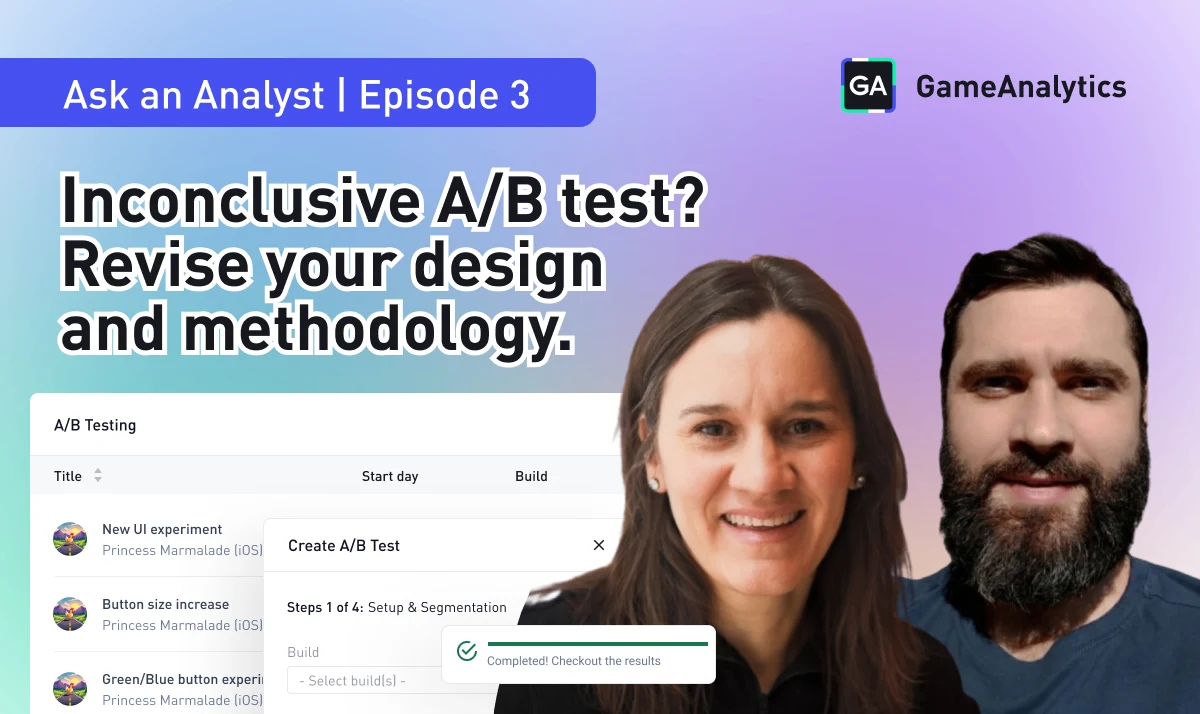
That is the core idea behind this conversation with Vojtech Svoboda, a Game Analyst at HOMA: a useful A/B test is not just about statistics. It is about choosing the right methodology, testing changes big enough to matter, and knowing in advance what the team will do if the result goes one way or the other. Watch the full conversation here.
Why so many A/B tests feel inconclusive
One of the clearest points in the discussion is that teams often overestimate the likely impact of what they are testing. Vojtech describes the pattern well: a team spends days designing and implementing a variant, expects a meaningful uplift, and then discovers that the change is too small to move the KPI in a meaningful way. In his words, “Small changes on the input cause small changes on the output.”
This is one of the biggest reasons tests feel noisy. The issue is not always the data. Sometimes the test is simply asking the system to detect a tiny signal in a noisy product environment. That is why Vojtech’s recommendation is unusually direct: if you are going to run a test, aim for high-impact changes.
Why bigger changes often make better tests
Many teams are cautious with experimentation, especially when product quality is involved. They do not want to disrupt the experience or risk damaging the game. That instinct is understandable. But it also leads to weak experiments.
Vojtech argues that if teams want tests that actually produce decisions, they need to stop testing tiny parameter adjustments and start testing bigger product shifts. He gives a strong example: instead of slightly tuning a stamina system, remove it entirely and see what happens.
His advice is simple: “Take big swings.”
That does not mean every change should be reckless. It means the test should be large enough to generate a measurable difference. If the change is too small, the result may tell you very little, even if the methodology is sound.
Why methodology matters more than teams think
Another major point in the conversation is that not all statistical approaches are equally practical for game teams. Vojtech argues strongly in favor of the Bayesian approach over the traditional Frequentist framework. His reasoning is operational as much as statistical: the setup is easier to follow, the results are easier to interpret, and teams are less likely to make mistakes that invalidate the outcome. He notes that many people misunderstand p-values and the limits of the Frequentist approach. A result above the threshold does not mean there is no difference. It only means the evidence is not strong enough to confirm one. That distinction gets lost often in product teams.
His conclusion is blunt: “If you want to avoid a very common pitfall, just go Bayesian.”
The broader lesson is that a test is only as useful as the team’s ability to interpret it correctly.
A/B tests need a clear goal, not a vague hope
A common experimentation mistake is running a test without being precise about what success means. Vojtech emphasizes that once a team decides to run a test, it needs to choose a target metric and make sure that metric aligns with the current product goal. That might vary depending on where the game is in its lifecycle. A soft launch title may prioritize retention or technical quality. A global title may focus more directly on ROAS, ROI, or LTV. But the important point is this: the test should not be trying to improve everything at once.
As he explains, there is an “eternal struggle between monetization and retention.” Increasing one often hurts the other. That makes a purely holistic pass/fail mindset less useful in experimentation. The team needs to know what tradeoff it is willing to make.
Not every result should be followed
One of the strongest parts of the discussion is the reminder that a statistically meaningful result is not always a strategically meaningful one. Vojtech gives an example of testing one starting hero versus three starting heroes. The variant produced a 0.5% uplift in day 1 retention. Technically, that was a real positive result. But operationally, the costs were too high. More complexity for designers, harder onboarding control, and more QA work for every future update made the change not worth implementing. That is why he warns against treating A/B testing as a kind of unquestionable rulebook. In his words, “An AB test is just a piece of information.”
A good team uses that information alongside context, cost, design complexity, and business priorities.
What makes a test actionable
A test becomes actionable when it answers a real decision.
That means the team should know, before the test begins:
- what metric matters most here
- what level of change would be meaningful
- what tradeoff is acceptable
- what the team will do if the test wins
- what the team will do if it loses
If nobody is actually willing to change the product based on the outcome, the test probably should not run yet. This is especially true when teams test changes they are emotionally attached to. A/B testing works best when it helps decision-making, not when it gets used to delay difficult decisions.
The best teams test throughout the lifecycle
Vojtech’s view on experimentation cadence is simple: test throughout the whole lifecycle, as long as the game has enough players to support it. His reasoning is that A/B testing is one of the best sources of objective product information available. But that does not mean every test should be followed automatically. It means teams should use experiments to learn continuously, then combine that learning with experience, exploratory analysis, and product context.
That is an important balance. Too many teams either over-worship experiments or underuse them entirely.
Final takeaway
The biggest lesson from this discussion is that many A/B testing problems are not really data problems. They are design problems. Teams test changes that are too small, chase metrics that are too broad, or expect experiments to deliver certainty where only tradeoffs exist. Vojtech’s advice is therefore refreshingly practical:
- aim for bigger changes
- use a framework the team can actually interpret
- choose one clear goal for the test
- do not treat a test result as the only truth
- remember that one strong exploratory analysis may be worth more than ten mediocre experiments
His final point is perhaps the most useful of all:
“Stop seeing AB test as some kind of a Holy Testament.”
A/B testing is powerful. But it works best when teams use it as one input into better decisions, not as a substitute for product thinking.
FAQ
Why do so many A/B tests feel noisy or inconclusive?
Because teams often test changes that are too small to create a measurable impact, or they use a methodology the team struggles to interpret correctly.
Should game teams test small changes or big ones?
In general, bigger changes are more likely to produce clear, actionable results. Small tweaks often create changes too minor to measure with confidence.
Why do some teams prefer Bayesian A/B testing?
Because it is often easier to set up, interpret, and communicate across teams than a Frequentist approach based on p-values and null hypothesis testing.
What makes an A/B test actionable?
A test is actionable when the team knows in advance what decision it will make if the result is positive, negative, or too small to matter.
Should every statistically significant test result be implemented?
No. A result can be statistically real but still not be worth the added cost, complexity, or operational burden.
How often should game teams run A/B tests?
As often as the player base and product stage allow, as long as the tests are designed to answer meaningful product decisions.